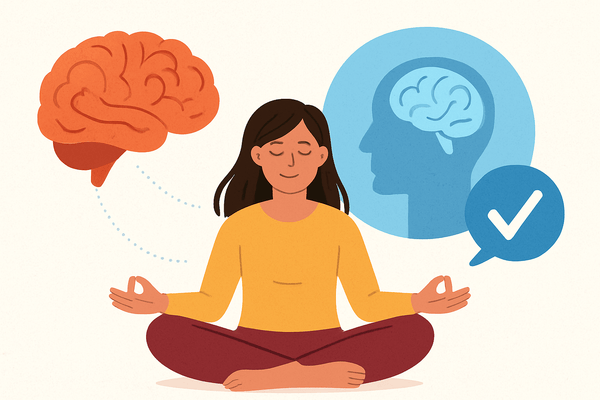
If earning a living and supporting a family is an external engineering project, then self-awareness can be called an internal one.
Let’s temporarily set aside the underlying relationship between awareness, consciousness and focus — modern neuroscience and psychology have basically explained these matters. (We’ll discuss the theory in follow-up blog posts.) Instead, let’s go straight to what to do and how to do it.
The Awareness Checklist
This awareness checklist covers multiple dimensions: bodily sensations, emotions, thoughts, behaviours, senses and environment. Each category contains awareness-points from the macro to the micro.
I. The Physical Self (Body)
This is your most direct portal into the subconscious. Trauma and automatic patterns are stored in the body.
1. Whole-body Posture
- Whole-body posture: Are you “contracted” (chest collapsed, arms crossed) or “open” (spacious)? Are you leaning forwards (urgent…) or leaning backwards (retreating…)?
- Body’s centre-of-gravity: Do you feel grounded in the soles of your feet (rooted), in the chest (anxious) or at the head (overthinking)?
- Symmetry: Are both sides of your body feeling balanced? Which side is tighter or heavier?
2. Musculoskeletal
- Micro-tension: Not just “my shoulders are tight”, but which muscle? Surface or deep?
- Unconscious micro-movements: Are you clenching your jaw? Is your tongue pressing the upper palate? Is your glabella (between eyebrows) ever so slightly creasing?
- Hands and feet: Are your fists relaxed or clenched? Are your fingers tapping unconsciously? Are your toes gripping the ground or relaxed?
- Default facial expression: When your face is “at rest”, what is the baseline state of your facial muscles? (Often reflects the baseline emotion.)
3. Visceral & Systemic
Breathing:
- Location: Is your breath in the chest, the belly, or only in the throat (shallow)?
- Rhythm: Is it steady, rushed, or interrupted by holding/ sighing?
- Quality: Is the breath “smooth” or “restricted”? Which is harder: inhalation or exhalation?
Circulation: - Heart-beat: Is it “pulsing” or “thumping”? Is it robust or faint?
- Blood-pressure feel: Do you sense pressure in your temples or skull?
- Blood flow: Can you feel warmth at the extremities (hands/feet) or coldness (circulatory constriction)?
Digestion: - Stomach: Is it “turbulent” (anxiety), “heavy” (suppression), “hollow” (yearning) or “warm” (relaxed)?
- Intestines: Do you sense movement or a “knotting” in your gut?
- Throat/Esophagus: Is there a sensation of “lump in the throat”, “foreign-body feeling” or “burning”?
4. Skin & Boundary
- Skin sensations: Itchiness, tingling, numbness, particular sensitivity in one region, goose-bumps.
- Temperature: Which areas are hot (energy concentrated/anger/shame) and which are cold (fear/dissociation)?
- “Energy boundary”: Can you sense your personal space around your body? When someone approaches, how is this space compressed or does a “sting” sensation arise?
II. The Emotional Self
Emotions are not merely “labels”, they are a synthesis of bodily experiences.
1. Texture of Emotion
- Primary emotions: joy, anger, sadness, fear, surprise, disgust.
- Compound emotions: For example “excited yet afraid” (before public speaking), or “sad yet relieved” (on seeing a child grow).
- “Physical form” of emotion: Does this emotion feel like a “solid” (heavy, congealed), “liquid” (flowing, turbulent) or “gas” (diffuse, vague)?
- “Temperature” of emotion: Is it a “burning” anger, or a “freezing” fear?
2. Background Mood / Atmosphere
- Emotional baseline: When no strong emotion is present, what is your default mood? Is it “grey”, “pale-blue” sadness, or “warm-beige” calm?
- Vague feelings: Those hard-to-name states like “emptiness”, “unease”, “restlessness”, “disconnection”, “meaninglessness”.
3. Dynamics of Emotion
- Trigger: What just happened (a thought? a sentence? a sound?) that sparked the emotion?
- Evolution: How did it rise? Where did it peak? How did it subside?
- “Secondary reaction”: Do you have another emotion about your emotion? (e.g., feeling guilt because you’re angry; feeling more anxious because you’re already anxious).
III. The Cognitive Self
This is the direct target of “cognitive re-evaluation”, but first you must notice them.
1. Form of Thought
- Internal dialogue “tone”: Whose voice is it? Yours, your parent’s, your teacher’s, or some internal critic?
- Tone of the voice: Is it harsh, sarcastic, fearful, or objective?
- Mental imagery: Are images popping up? Are they replays of the past, or catastrophic predictions of the future?
- Thought-flow speed: Are thoughts “slowly trickling”, “normal speed”, or “racing like wild horses”?
2. Content of Thought (core of cognitive-behavioural therapy)
- Automatic thoughts: your “first reaction” to a situation. Example: [Situation] A friend doesn’t reply to your text → [Automatic thought] “He must be mad at me.”
- Labels & judgments: “I’m such a failure”, “This is so stupid”, “He’s just a jerk.”
- Rules & “shoulds”: “I must be perfect”, “I shouldn’t feel sad”, “Others should understand me.”
- Cognitive distortions:
- All-or-nothing: “If I don’t get full marks, I’m worthless.”
- Catastrophising: “If I mess this up, my life is ruined.”
- Mind-reading: “I know they are laughing at me.”
- Emotional reasoning: “I feel anxious, so there must be danger.”
3. Underlying Beliefs
- Core beliefs about Self, Others, World:
- Self: “I am lovable / unlovable”, “I am capable / incapable”, “I am safe / unsafe”.
- Others: “People are trustworthy / untrustworthy”, “People are here to help me / to hurt me”.
- World: “The world is fair / unfair”, “The world is full of opportunities / full of threats”.
- Narratives & “life script”: What story do you tell yourself? (“I am always the one abandoned”, “I always have to fend for myself”, “Good luck never happens to me”).
IV. The Behavioural Self
These are the outlets through which the subconscious attempts to solve problems via action.
1. Impulses (pre-action urges)
Fight / Flight / Freeze / Fawn:
- Fight: urge to argue, to rebut, to raise your voice, to interrupt.
- Flight: urge to leave the room, end the conversation, check your phone, distract yourself, procrastinate.
- Freeze: sudden blankness, body goes rigid, you want to “play dead”.
- Fawn: urge to apologise immediately, to over-praise, to agree with something you actually disagree with, to soothe the other’s emotions.
2. Micro-behaviours
- Unconscious habits: leg-shaking, pen-spinning, nail-biting, skin-picking, playing with hair.
- Speech habits: do you frequently say “uh”, “um”, “like”, “sorry”?
- Breathing pattern changes: under specific circumstances (e.g., your boss asks a question) do you suddenly hold your breath?
3. Relational behaviours
- Eye contact: Are you avoiding it, staring, or softly observing?
- Physical distance: Are you unconsciously moving closer to or further away from the person you are talking to?
- Listening style: Are you truly listening to the other person, or waiting for your turn to speak / craft your rebuttal?
V. The Perceptual & Environmental Self
How we receive the world also reflects how our subconscious is filtering it.
1. Sensory Tuning
- Hearing: Are you hyper-alert to threatening sounds (e.g., harsh tone, criticism) or are you shutting down hearing (you don’t listen)?
- Vision: Is your field of view open, or narrowed into a “tunnel view” (only seeing immediate threat or task)? Do you unconsciously “scan” your environment for danger?
- Touch: Are you overly sensitive to clothing tags, certain textures?
- Smell / Taste: Does a particular scent instantly trigger a memory or emotion?
2. Environmental Response
- Sense of space: Does this room feel “safe”, “oppressive”, “exposed” or “comfortable”?
- Light / sound: Do bright lights or loud voices make you feel “energised” or “drained”?
- Atmosphere: Can you feel the “tension” or “relaxation” in a room (e.g., the meeting room vs a lounge)?
How to Use This Checklist
- Don’t treat it as a “to-do list”: This is not something you must complete. It is a “menu”.
- Start with what is most obvious: When you feel discomfort, start from the strongest sensation. Is it your stomach knotting? Or a thought in your mind? Then anchor in the list. For example: “I notice my breath is stuck in my throat (I.3), my jaw is clenched (I.2), and there’s a thought ‘I screwed up’ (III.2).”
- Use “trigger-points” practice: When you feel (anxiety/anger/depression), pause. Ask: “What am I noticing right now?” Then pick the most fitting description from the list. Example: “I notice my ‘fawn’ urge (IV.1), I really want to agree immediately though I don’t.”
- From awareness to re-evaluation:
- Awareness (see): “I notice my urge to ‘fawn’ (IV.1). I strongly want to agree though I disagree.”
- Cognitive re-evaluation (analyse): “Where does this urge come from? Ah—it comes from the core belief ‘if I disagree, they will be angry’. Is this belief 100% true right now? If I disagree, will the sky fall? Could I express myself in a way that honours me and the other?”
Note: You may use a “awareness journal”, which helps cultivate and consolidate sensitivity to your own awareness. You can read this article to learn about the principles behind it.
This checklist should be sufficient for you to explore deeply for a long period. The key is consistent, curious, non-judgmental practice.

Leave a comment
This site is protected by hCaptcha and the hCaptcha Privacy Policy and Terms of Service apply.